Why Blended Learning is the Future of Wilderness Medicine
For decades, the standard for wilderness medicine training was a "cram-and-jam" model. You’d drive hours to a remote camp, sit in a stuffy room for eight hours a day listening to lectures, and then squeeze in a few scenarios before the sun went down. By day four, your brain was mush, and by day eight, you were struggling to remember the difference between a tension pneumothorax and a panic attack.
In the industry, there’s been a persistent myth that "online" means "lower quality." Some of our legacy competitors even try to deny certifications from blended programs, claiming that if it isn't 100% in-person, it isn't real training.
They couldn't be more wrong.
At Base Medical, we believe that blended learning, the strategic combination of high-level online theory and intensive, hands-on field sessions, is not just a "convenient alternative." It is actually a superior educational model that produces more competent, confident, and resilient responders.
What is Blended Learning, Anyway?
Before we dive into the "why," let’s clear up the "what." A common misconception is that a wilderness first responder course taken through a blended model is just "watching videos."
In reality, blended learning is a flipped classroom.
Phase One (The Theory): Students complete 30 to 50 hours of self-paced, interactive online modules. They learn the critical concepts of wilderness medicine at their own pace. They can re-watch a lecture as many times as they need to until they truly get it.
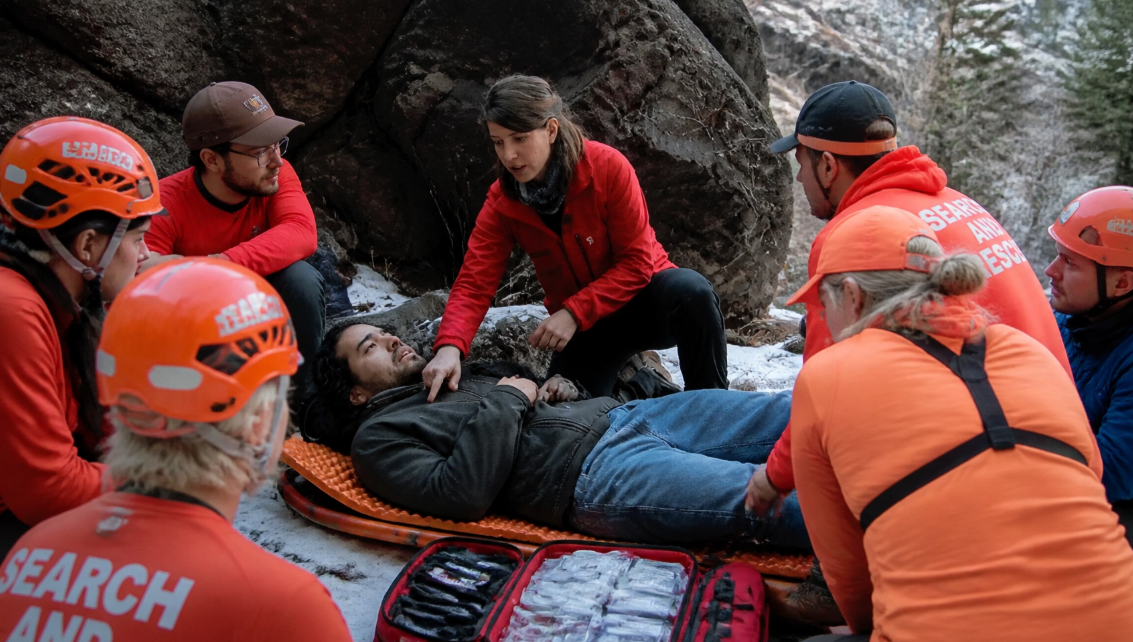
Phase Two (The Skills): Once the cognitive heavy lifting is done, students arrive for the in-person field days. Because they already know the "why," 100% of the field time is dedicated to the "how." It’s all about splinting, patient packaging, and high-stress scenarios in the dirt. In fact, Base Medical requires instructors to adhere to a strict 3:1 active to passive learning ratio and white boards and power-points are strongly discouraged during the hands-on training.
1. Accessibility: Breaking the Geographic Barrier
Traditional wilderness medicine training has a massive accessibility problem. If you live in a rural area or work for an underserved Search and Rescue (SAR) team, getting certified often requires taking a full week off work, paying for travel, and finding lodging.For many volunteers and non-profit outdoor educators, those barriers are insurmountable.Blended learning changes the math. By moving the didactic portions online, we reduce the required in-person time by 50% or more. This makes a hybrid WFR certification (with its subsequent field days) accessible to people who simply can't disappear for ten straight days. It allows SAR teams in remote regions to maintain high standards without draining their limited budgets on travel logistics.
2. Scalability for SAR Teams and Non-Profits
When we talk to Search and Rescue commanders, their biggest headache is often training consistency. When a team has 50 volunteers with varying schedules, trying to get everyone to the same 80-hour in-person course is a logistical nightmare.The blended model is built for scale. Teams can have their members complete the online search and rescue training modules throughout the year. Then, the team can host a focused weekend of field skills. This creates a sustainable, scalable in-house training solution. Instead of sending one or two people away to get trained, an entire organization can level up simultaneously. We’ve designed our group training programs specifically to support this, helping outdoor non-profits and youth corps create training ecosystems that don’t break the bank.
3. The Science of Better Learning
There is a cognitive phenomenon called the "forgetting curve." If you cram 80 hours of new information into your brain in one week, you will likely forget up to 70% of it within a month if you don't use it immediately.
Blended learning fights the forgetting curve through spaced repetition.
When a student engages with the material online over several weeks before their field session, they are building long-term neural pathways. They aren't just memorizing for a test; they are internalizing concepts. By the time they step into a wilderness patient assessment scenario in the snow, the theory is already "second nature." They can focus on the physical nuances of the rescue because their brain isn't struggling to remember the steps of the secondary survey.
4. Maximizing the "Dirt Time"
Ask any Wilderness First Responder what the most valuable part of their course was, and they’ll say "the scenarios."
In a traditional 10-day course, you spend a huge amount of time sitting on chairs. In a blended course, the "dirt time" is the main event. Because the instructor doesn't have to spend three hours standing at a whiteboard explaining the circulatory system, they can spend those three hours in a rock pile, coaching you through a complex multi-patient triage.
This hands-on focus is where true competence is built. It’s where you learn how hard it is to tie a knot with cold fingers or how to communicate with a panicked patient while a medical evacuation helicopter is hovering nearby.
5. Addressing the Industry "Gatekeeping"
We know the pushback. Some legacy organizations claim that a remote wilderness first aid certification or a hybrid WFR isn't "legitimate."
Here is the truth: The Wilderness Medicine Education Collaborative (WMEC) standards were developed with a specific subset of the outdoor community in mind and may not fully address the educational needs of all populations requiring wilderness medicine training. In addition, the educational requirements suggested within these standards can create financial, geographic, and time barriers that limit access for volunteer SAR teams and non-profit organizations. This is particularly important because SAR responders are often the true first responders to wilderness medical emergencies and may benefit most from accessible, wilderness-specific medical education.
The resistance to blended learning often isn't about educational quality: it’s about protecting an outdated business model. The traditional "destination course" model is expensive and exclusive. The blended model is inclusive and efficient.
We’ve seen the results in the real world. Just look at the story of a Base Medical WFR student who found herself on a Mt. Rainier rescue just ten days after graduation. She didn't succeed because she sat in a classroom for ten days; she succeeded because her training allowed her to master the theory at home and then master the application in the field.
The Future is Blended
The outdoors is for everyone, and we believe the training to stay safe in the outdoors should be, too.
By embracing technology, we aren't "skimping" on the hands-on skills. On the contrary, we are protecting them. We are making sure that when you are in the field with an instructor, every second counts.
Whether you are a seasoned SAR professional looking for recertification or a mountain guide just starting your journey, the blended model offers a path that is more flexible, more affordable, and: most importantly: more effective.
Don't let the "online-only" labels fool you. The future of wilderness medicine is one where we use the best digital tools available so that we can be our best when we're miles away from a cell tower.
Ready to elevate your training?
Individuals: Explore our Wilderness First Responder and Wilderness First Aid courses.
SAR Teams: Request a customized group training solution for your organization.
Professionals: Dive into our advanced SAR modules, from helicopter ops to land navigation.